The Window
What's actually happening to physician careers
Three things every physician should understand about the next decade. Five-minute read.
The Final Frontier
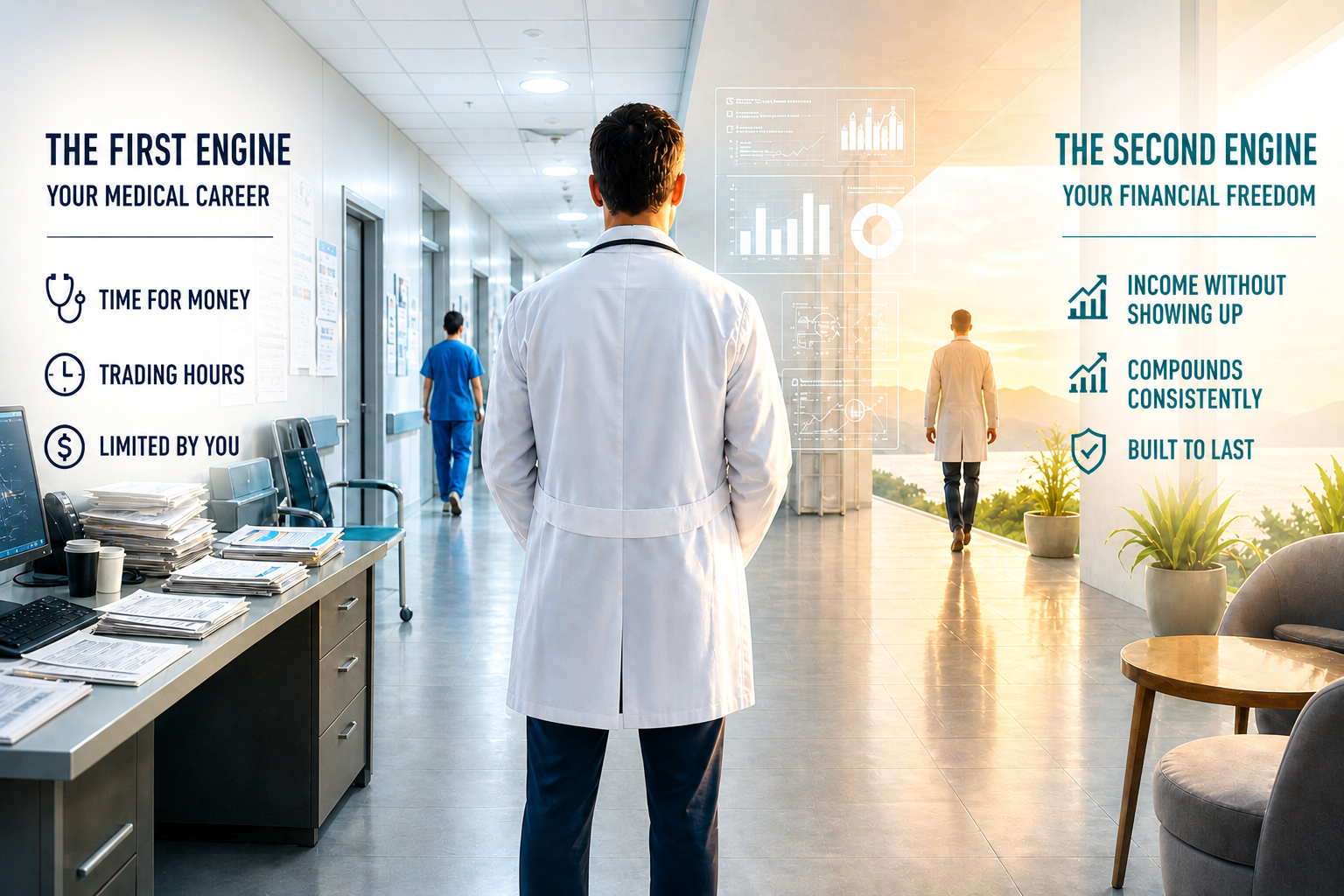
We are living in the final frontier of building wealth the way physicians have always built it.
Through training. Through expertise. Through showing up, and being irreplaceable.
That model is not ending in fifty years. It is not ending in twenty.
The pace of change in medicine is accelerating. Stanford radiologists are now reviewed by AI tools that match or exceed human accuracy on specific scan types. Autonomous AI screening is being approved for diabetic retinopathy detection in primary care. Documentation AI is drafting clinical notes at a speed and quality that most attending physicians could not match a decade ago. Each of these tools is, individually, just a tool. Together, they are the early signal of a much larger shift.
The professionals who come through periods of disruption, not just surviving, but genuinely free , are not the ones who earned the most.
They are the ones who built a second engine alongside the first.
Income that arrives whether they show up to work or not. Capital that compounds in the background. A financial structure that doesn't depend on any single paycheck, any single market, or any single year going exactly as planned.
That second engine is what this app exists to help you build.
One important thing. This is not a doom forecast. The window is still open. Physicians today have access to tools, capital, and timing that physicians a generation from now will not. The fact that you're reading this means you have time to act.
The Submarine Principle

Picture two things. A plane, and a submarine.
If you fly often, and most physicians do, you know what turbulence feels like. When the wind picks up at altitude, the plane feels it immediately. The whole experience is at the mercy of conditions above the surface.
The submarine operates underwater. Completely independent of whatever is happening above. When the wind howls and the waves surge, the submarine doesn't notice. It stays steady. It doesn't know there's a storm.
That is what uncorrelated means. Two assets moving independently of each other.
If the stock market is the plane, and it is, then needs-based real estate is the submarine. When the market drops 20% because an AI tool threatens to disrupt the software sector, when a Fed announcement sends technology stocks spiraling, when geopolitical tension creates volatility across every publicly traded company simultaneously,
The rent check from a 300-unit apartment community still arrives.
Because people still need a place to live.
This is not theory. It is the structural reality of three asset classes:
Multifamily housing. Approximately 1 in 9 Americans lives in multifamily housing , roughly 37 million people. The need does not pause because the Dow had a bad week.
Senior living communities. People do not stop aging. Demand for senior housing tracks demographics, not market sentiment. With 10,000 Americans turning 65 every day, this trend has decades of structural runway ahead of it.
Self-storage. Demand for self-storage actually increases during economic disruption, divorces, downsizing, life transitions. Counter-cyclical by nature.
When budgets get tight, people cancel vacations. They cut subscriptions. They skip restaurants.
They do not give up the roof over their heads. They do not stop aging. They do not stop needing somewhere to store their belongings during life transitions.
That is what calm money actually means. Not money that ignores risk. Money that was never designed to be exposed to the risks most people are most afraid of.
The Tax Drain
Here's something most financial advisors will never show physicians.
Not because they are hiding it. Because many of them genuinely do not know it exists.
The tax code was not written to treat all income equally. It was written to reward specific economic behaviors, building housing, creating jobs, funding infrastructure. The result is a system where the source of your income determines how it is taxed, far more than the amount.
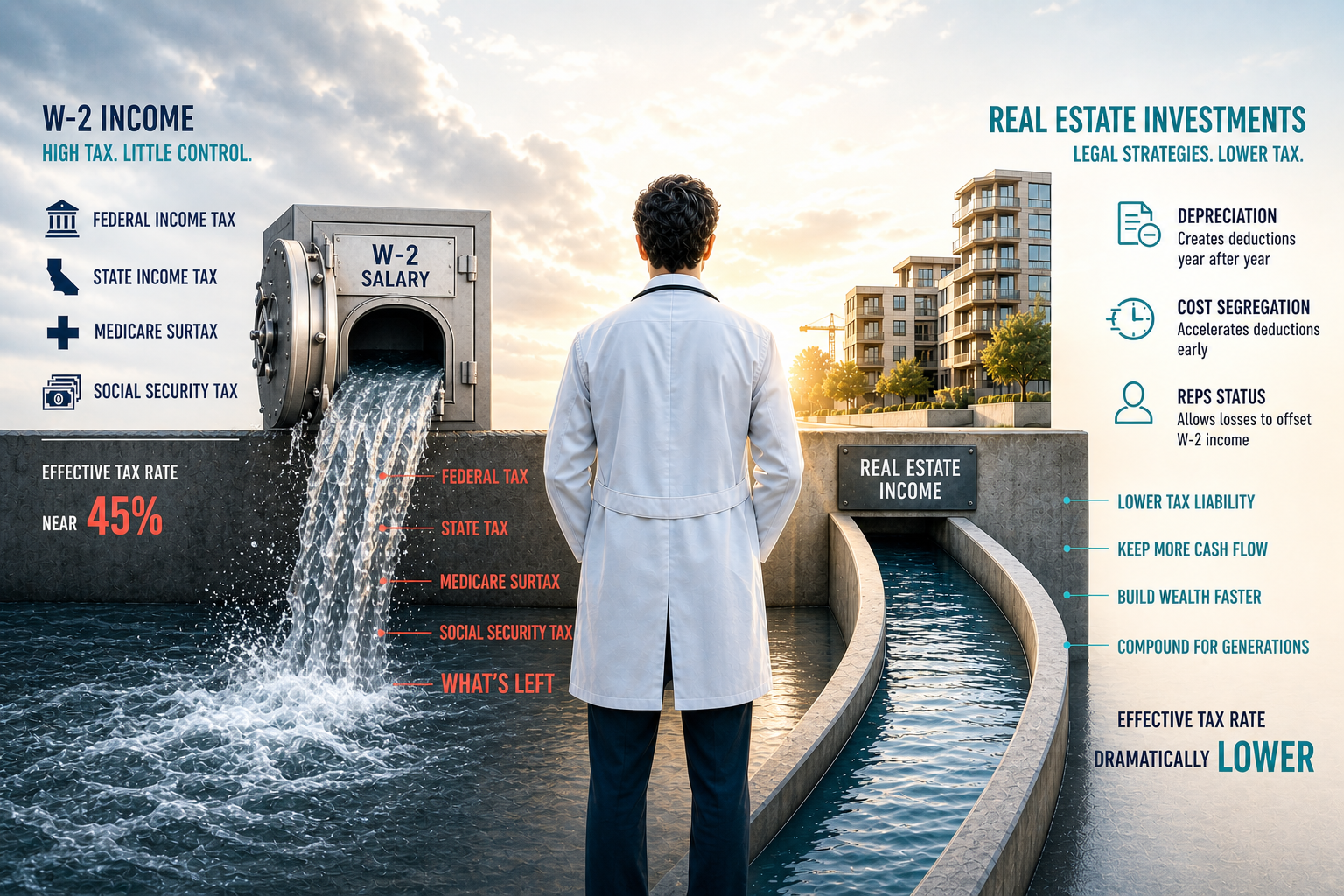
W-2 income, your salary, your hospital pay, your group practice distribution, is taxed at the highest rates in the system. Federal income tax. State income tax. Medicare surtax. All of it hitting earned income hardest.
A physician earning $400K on a W-2 can face an effective tax rate near 45%. The same income earned through a portfolio of real estate investments, using legal, IRS-sanctioned strategies that the largest institutional investors use every day, can result in a dramatically lower effective rate.
Three mechanisms drive this:
Depreciation lets you deduct the cost of a building over time. Even while the property is appreciating in value and generating real cash flow, the IRS treats it as a paper loss on your return.
Cost segregation accelerates those deductions into the early years of ownership , front-loading the tax benefit exactly when high earners need it most.
Real Estate Professional Status (REPS), for certain household structures, especially when one spouse can qualify, allows real estate losses to offset not just passive income, but W-2 income directly.
The right strategy depends entirely on your specific income profile, your household structure, and where you are in your career. The Freedom Dictionary inside this app explains each of these concepts in detail. Your CPA can help you implement them.
The point is not to teach you the mechanics in five minutes. The point is to make sure you know they exist, because most physicians don't.
You've now seen the three forces that make this moment different.
The next step is finding out where you stand.